The Borrowed Skill: Passing Along Know-How Without a Formal Class
Informal skill-sharing lets neighbours learn during an ordinary job, without enrolling in a formal class: choose a clear task and offer a relaxed turn.
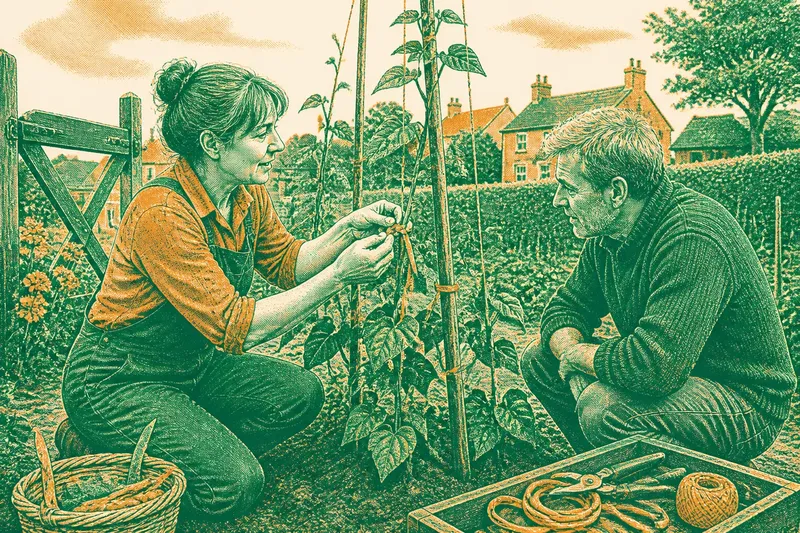
Informal skill-sharing lets a neighbour learn while you mend a gate latch or tie up beans, without asking either of you to attend a formal class. The task supplies a reason to meet, and the learner can watch, ask questions or try one part as the work unfolds.
That difference is practical, not just a matter of labels. A class usually has a planned session and a defined learner role; a shared task can begin with a casual invitation, adapt to the time available and end when either person has had enough. It also means nobody needs to prepare a lesson or promise a regular commitment.
Task before lesson
Choose a job with a visible result and a natural stopping point. Matching a hinge to its screws is easier to join than tidying an entire shed, while tying one plant to a support offers a clear beginning and end.
Pause after showing one action. You might demonstrate how to loop a soft tie around a bean stem, then leave the next stem for the other person. That small gap lets them ask, watch again or have a turn without interrupting a long explanation.
Keep the invitation as specific as the task: “I’m tying up these beans by the greenhouse; would you like to watch or try one?” Compared with a formal class, there is no need to set a curriculum, gather a group or keep to a timetable. The neighbour can simply decline, observe for a moment or join in.
Make the invitation easy
Ask in a quiet, ordinary moment, perhaps while chatting at the gate or after a community tidy-up. A public invitation can make someone feel obliged to answer in front of others, so leave room for a simple “not today”.
Be clear that help is optional and does not create a debt. “I’m cleaning the secateurs on Saturday; come and watch if you fancy it” offers company and a chance to learn, not an expectation that the neighbour will do your jobs in return.
It is not worth making a poster, taking attendance or planning a full lesson for one small shared job. If interest grows, neighbours can decide together whether they want a larger gathering; until then, keep the exchange easy to arrange.
Choose a first turn
Ask whether the person would rather watch or try. Some people need to see the whole movement first; others understand it by doing. Show one action at a time, using ordinary words, then offer the tool or material and wait before stepping in.
For a plant tie, point out how it supports the stem without pulling tight. If the learner hesitates, ask what feels unclear before taking over. They may want another demonstration, a different grip or simply a little more time.
Agree on a small, complete contribution before handing over. A learner might choose a fastener from a sorted tray or make the last turn on a simple, suitable job while you steady the piece. Say plainly that they can stop or hand the task back.
Informal skill-sharing questions?
How is this different from a class?
A formal class usually has a planned lesson, a set time and a learner group. Informal skill-sharing starts with a real job and can change pace or end whenever both neighbours are ready.
What if someone only wants to watch?
Watching still gives them a chance to see the tools, sequence and result. Offer another turn later only as a fresh invitation, not as an assumed next step.
Does the learner need to repay the favour?
No: make clear that joining is voluntary and there is no work owed in return. Neighbours may choose to exchange skills another time, but that should be a separate, freely accepted offer.
What if the job needs specialist knowledge?
Do not use a casual demonstration for work involving mains electricity, gas, structural repairs, hazardous chemicals or dangerous machinery. Choose a safe adjacent task or consult a suitably qualified professional where needed.
Explain what matters
Cover what to do, what to notice and what to avoid, then let the learner ask about details. When pruning, for example, identify the stem to remove, show where the cut should sit and point out a nearby shoot to protect.
People may have different methods because their tools, soil or materials differ. Explain why you favour one approach without insisting it is the only sensible one. If a product label, manufacturer’s instructions or local rules apply, follow them rather than improvising.
Questions often reveal a detail an experienced person has stopped noticing. If you are unsure how to answer, say so; a neighbourly exchange is a poor place to turn a guess into instruction.
Keep the task suitable
Informal teaching suits only work that can be done with appropriate equipment and sensible safeguards. Even a familiar job is a poor fit if the setting is rushed, the learner is uncomfortable or a tool is damaged. You can explain how to spot wear without asking someone to use unsafe equipment.
Imagine you are showing a neighbour how to tie climbing beans to twine. You have soft plant ties and a healthy stem ready; first, you show one loose loop and point out that it should support rather than squeeze the stem. Next, you ask whether they would like to try the next tie, then let them make the loop while you stay nearby. The expected visible result is a stem supported without being pulled tight; if they prefer not to try, you finish the tie and they can still ask questions. The exchange has worked without becoming a class or turning the task into an obligation.
Close the exchange well
At the end, ask what part made sense or felt awkward. That gives the learner room to describe what they noticed, rather than having to prove they remember every detail.
Put tools away together and name anything left unfinished, so nobody is unsure who will handle it. If another chance comes up, offer it as a new invitation; a single visit does not make someone the regular helper.
A brief follow-up can keep the connection friendly: mention how the beans are climbing or ask whether the knot was comfortable to tie. Informal skill-sharing works best when the know-how travels alongside respect for the other person’s time, confidence and choice.